When a 60-foot oak tree crashed into the main parking lot at a prominent New England university during a 2023 nor’easter, it wasn’t just the crushed vehicles that caught administrators’ attention. The subsequent investigation revealed the tree had shown signs of internal decay for months, signs that could have been detected through routine arborist assessments. The resulting insurance claims, legal fees, and operational disruption cost the institution well over one hundred thousand dollars – expenses that could have funded comprehensive preventive tree health management for their entire campus for multiple years.
This scenario plays out repeatedly across Massachusetts and Rhode Island educational institutions, where mature tree canopies create both stunning campuses and significant liability exposure. For university administrators in Medfield, Norfolk, Walpole, and Providence County, the question isn’t whether tree-related incidents will occur, but how to prevent them from becoming financial disasters.
Key Takeaways
- Proactive tree health management costs significantly less than reactive emergency response, with systematic programs providing substantial savings compared to crisis-driven approaches that require immediate mobilization and premium rates.
- Massachusetts property owners face legal liability for diseased or structurally compromised trees under state law, making documented professional arborist assessments essential for demonstrating due diligence in property management.
- Regular certified arborist evaluations significantly reduce liability exposure while providing essential documentation for insurance claims defense and regulatory compliance requirements.
- Institutions operating in both Massachusetts and Rhode Island must navigate complex dual regulatory frameworks, requiring specialized expertise in cross-border environmental management and permitting processes.
- Systematic tree health management programs typically provide a strong return on investment through reduced emergency costs, avoided liability claims, and operational continuity during severe weather events.
- Professional assessment and early intervention prevent many predictable tree failures, protecting both campus safety and institutional finances through the identification of structural defects and health issues before they become emergencies.

Storm damage can create immediate safety hazards and significant liability exposure for institutional properties without proper preventive tree health management.
Understanding Tree-Related Liability Risks for Massachusetts Universities
Universities and large campuses face unique liability challenges that residential property owners rarely encounter. High pedestrian traffic, vehicle access, historic buildings, and round-the-clock operations create scenarios where tree failure can result in catastrophic consequences.
Legal Framework Under Massachusetts Law
Massachusetts operates under what legal experts call the “Massachusetts Rule” for tree liability. While property owners typically aren’t liable for damage from healthy trees, diseased, damaged, or structurally compromised trees create significant legal exposure. The key distinction lies in whether the property owner knew or should have known about the tree’s condition.
For educational institutions, this creates a higher standard of care. Courts often expect institutional property owners to maintain more rigorous inspection schedules than individual homeowners. The reasoning is straightforward: universities have greater resources, professional maintenance staff, and responsibility for larger numbers of people on their premises.
Massachusetts General Laws Chapter 242, Section 7 imposes penalties up to three times actual damages for willful tree destruction, but it also establishes the principle that property owners must exercise reasonable care in tree maintenance. For campus administrators, “reasonable care” increasingly means documented, professional assessment by Certified Arborists.
Financial Impact of Tree Failure Claims
The financial consequences of tree-related incidents extend far beyond immediate cleanup costs. United Educators, which provides liability insurance to educational institutions, reports that tree-related claims can reach significant amounts per incident, with the most severe cases involving personal injury that can exceed hundreds of thousands of dollars.
These costs compound quickly when institutions face emergency tree removal, property damage repair, legal defense costs, increased insurance premiums, and operational disruption, including lost productivity, event cancellations, and facility closures.
The most expensive element often isn’t the immediate damage but the long-term financial impact. Insurance companies view tree-related claims as indicators of poor property management, leading to higher premiums that persist for years.
When compared to the cost of regular arborist assessments and preventive treatments, reactive emergency responses can be several times more expensive.
Common Risk Scenarios on Educational Campuses
Southeastern Massachusetts campuses face several predictable risk scenarios that systematic tree health management can address:
- Storm-Related Failures: New England nor’easters and summer thunderstorms create extreme wind loads. Trees with compromised root systems, internal decay, or structural defects become projectiles during severe weather events.
- High-Traffic Zone Hazards: Areas around dormitories, dining halls, libraries, and parking structures see constant pedestrian and vehicle traffic. A falling branch in these zones affects multiple people simultaneously.
- Event-Related Exposure: Graduation ceremonies, campus tours, outdoor classes, and recreational events concentrate large groups under tree canopies. Special events often occur during spring and fall when many tree failures happen due to seasonal stress.
- Historic Tree Challenges: Many New England campuses feature century-old trees that are both aesthetic treasures and structural time bombs. These trees require specialized assessment techniques to detect internal decay while preserving their historic value.
Why Waiting to Act on Tree Care Costs Campuses More
Most educational institutions approach tree care reactively, responding to problems only after they become visible or dangerous. This approach seems cost-effective in the short term but creates exponentially higher expenses over time.
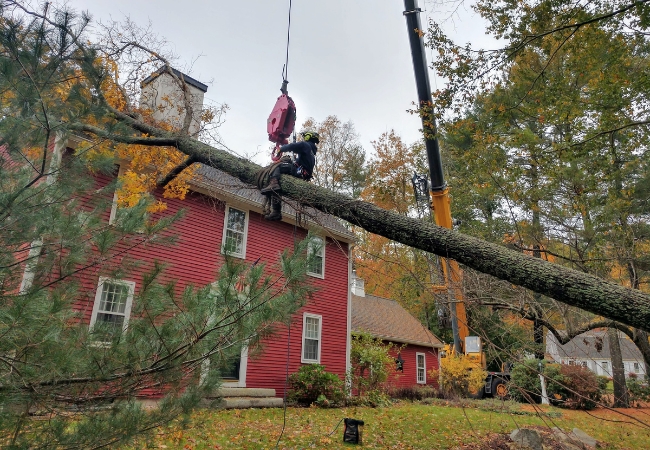
Emergency tree removal requires specialized equipment and immediate response, costing significantly more than preventive tree health management programs.
Emergency Response Expenses
When trees fail unexpectedly, everything becomes more expensive. Emergency tree services typically cost significantly more than planned maintenance because they require immediate response outside normal business hours, specialized equipment mobilization on short notice, coordination with utilities or emergency services, expedited permitting for emergency removals, and premium rates for weekend and holiday work.
The financial impact extends far beyond the immediate service costs. Emergency situations often occur at the worst possible times – during campus events, at the start of academic terms, or when facilities are most in demand. This timing amplifies the operational and financial consequences for educational institutions.
Understanding how proper pruning prevents storm damage is essential for institutional properties that face regular exposure to severe weather events.
Insurance Claims and Premium Increases
Tree-related insurance claims create long-term financial consequences that extend far beyond the immediate incident costs. Insurance companies evaluate institutional risk management practices, and repeated tree incidents signal inadequate property maintenance protocols to underwriters.
More significantly, claims create coverage gaps. Many policies exclude “known hazards,” meaning that if an institution is aware of problematic trees but fails to address them, insurance coverage may be denied entirely. This places the full financial burden of incidents directly on the institution.
Disruption to Campus Operations
The operational costs of tree failures often exceed direct property damage. When trees block access roads, damage utilities, or create safety hazards, entire sections of campus may become unusable.
Consider the cascading effects:
- Classes relocated or cancelled
- Events postponed or moved to alternative venues
- Parking areas closed during peak demand periods
- Utility services interrupted
- Emergency vehicle access compromised
- Tour routes altered during admissions season
“We’ve worked with several educational institutions in Norfolk and Bristol counties, and the pattern is always the same. Administrators think they’re saving money by waiting until trees become obvious problems, but emergency responses are much more expensive than preventive care. More importantly, you can’t control the timing of emergencies, so they always seem to happen during the worst possible moments.” – Kevin Johnston, Regal Tree Owner
How Systematic Tree Health Management Programs Work
Systematic tree health management transforms tree care from crisis response to predictable, budgetable maintenance. These programs combine regular assessment, preventive care, and strategic planning to minimize both risks and costs.
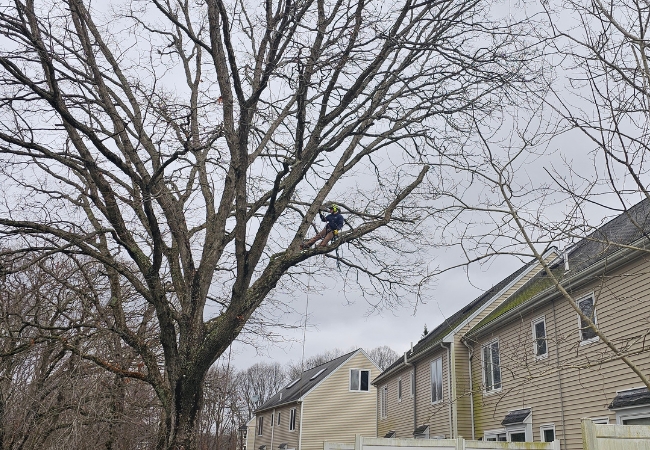
Regular professional tree assessments by Certified Arborists identify structural issues and health problems before they become costly emergencies.
Regular Risk Assessments by Certified Arborists
The foundation of any effective program is professional assessment by ISA Certified Arborists who understand both tree biology and liability management. These assessments go far beyond visual inspection to include:
- Structural Evaluation: Assessment of trunk integrity, branch attachments, root system stability, and load-bearing capacity. Advanced diagnostic tools, like sonic tomography, can detect internal decay invisible to visual inspection.
- Health Analysis: Evaluation of pest infestations, disease symptoms, environmental stress factors, and overall vitality. Many tree failures result from gradual health decline rather than sudden structural problems.
- Risk Rating: Systematic scoring of each tree based on failure probability, target analysis (what could be damaged), and consequence assessment. This creates prioritized action plans for budget allocation.
- Documentation Standards: Professional assessments create legal documentation demonstrating due diligence in property management. This documentation proves essential in liability defense and insurance claims.
Preventive Care and Early Intervention
Systematic programs emphasize treatments that strengthen trees and prevent problems rather than reacting to crises:
- Structural Pruning: Removing defective branches, improving weight distribution, and reducing wind resistance before storms occur. Proper pruning extends tree life and reduces the risk of failure by 40-60%.
- Plant Health Care: Targeted fertilization, pest management, and disease prevention based on soil analysis and tree species requirements. Healthy trees resist environmental stress and structural problems more effectively. For institutions dealing with sick or damaged trees, recovery programs can often restore health without removal.
- Support Systems: Cable and bracing installations for structurally compromised trees that have historic or aesthetic value. These systems can extend tree life by decades while maintaining safety.
- Root Zone Management: Soil improvement, drainage correction, and root protection in high-traffic areas. Many campus tree problems originate with soil compaction and root damage from pedestrian traffic.
Documentation for Liability Protection
Professional tree health management programs create comprehensive records that serve multiple purposes:
- Assessment Reports: Detailed documentation of each tree’s condition, recommended treatments, and risk level. These reports demonstrate professional management standards in legal proceedings.
- Treatment Records: Documentation of all maintenance activities, timing, and effectiveness. This creates a paper trail showing responsive property management.
- Budget Planning: Multi-year maintenance schedules that transform unpredictable emergencies into manageable annual expenses. Administrators can budget for systematic care instead of facing unexpected emergency bills that can significantly impact institutional finances.
- Regulatory Compliance: Many municipalities require permits for tree work, and some mandate professional assessment for certain removals. Systematic programs ensure all regulatory requirements are met before problems develop.
Frequently Asked Questions
What makes university tree management different from residential properties?
University tree management involves significantly higher liability exposure due to increased pedestrian traffic, vehicle access, public events, and round-the-clock operations. Educational institutions also face different legal standards, with courts expecting more rigorous maintenance protocols from institutional property owners compared to individual homeowners. Additionally, campus trees often include historic specimens requiring specialized care techniques and regulatory compliance across multiple jurisdictions.
How often should campus trees be assessed by Certified Arborists?
Most risk management experts recommend professional assessments every 2-3 years for healthy mature trees, with annual evaluations for trees showing any signs of stress, structural defects, or health decline. High-risk areas, such as walkways, parking areas, and event spaces, may require more frequent assessment. Trees with support systems or those recovering from treatment should be evaluated annually to monitor effectiveness and adjust care protocols.
What documentation is needed for liability protection?
Comprehensive documentation should include professional assessment reports with risk ratings, photographs, treatment recommendations, and timeline priorities. Maintenance records documenting all pruning, treatments, and interventions with dates and methods used are essential. Budget planning documents showing a systematic approach to tree care, regulatory compliance records including permits and approvals, and emergency response protocols all contribute to demonstrating professional property management standards in legal proceedings.
How do tree health management programs reduce insurance costs?
Insurance companies view systematic tree health management as a proactive risk reduction measure, which can positively impact institutional policies. More importantly, systematic programs prevent the claims that typically trigger rate increases following tree-related incidents. Programs also reduce the likelihood of coverage exclusions for “known hazards” and provide documentation supporting claims defense when incidents do occur.
What are the compliance requirements for institutions operating in both MA and RI?
Cross-border institutions must understand different permitting thresholds, protected species lists, and contractor licensing requirements in each state. Massachusetts and Rhode Island have different standards for wetland buffers, tree protection ordinances, and removal permit requirements. Working with tree care companies certified in both states, like Regal Tree & Shrub Experts, ensures compliance with all applicable regulations while streamlining administrative oversight.
Protect Your Institution’s Future with Professional Tree Health Management from Regal Tree & Shrub Experts
Systematic tree health management programs provide superior liability protection, cost savings, and operational reliability compared to reactive approaches. For universities and large campuses in southeastern Massachusetts and Providence County, professional tree care isn’t optional – it’s essential risk management.
Regal Tree & Shrub Experts brings unique advantages to institutional tree health management. Our ISA Certified Arborists understand both the biological complexities of New England trees and the liability challenges facing educational institutions. We’re certified to work in both Massachusetts and Rhode Island, ensuring seamless service and regulatory compliance for cross-border properties.
Contact Regal Tree & Shrub Experts today at 774-719-2450 for a comprehensive assessment of your institutional property. Let us show you how systematic tree health management can protect your campus, reduce your costs, and provide the peace of mind that comes from professional risk management.