In Norfolk County, pests move easily through the connected canopy along the Route 1 corridor. That means the chewed leaves, bare branches, or thinning crown you saw this summer can mean tree disease in fall or a pest that’s still living in the tree.
Treatment doesn’t end with the growing season, but each pest has its own window. Missing that window narrows the options you have for your tree.
Key Takeaways
- Spongy moth egg masses stay on the bark all winter and hatch in early May, so removing them before then is your best chance to act.
- Hemlock woolly adelgid feeds from mid-October to early March, and dormant oil spray goes on from late March into April, before buds open.
- Emerald ash borer treatment has been effective on infested ash trees treated before the crown shows more than about 30% dieback.
- Sunken, splitting bark points to canker, while blotchy leaf spots can point to anthracnose, which calls for raking leaves rather than spraying.
- Spotted lanternfly egg masses survive typical New England winters, so scraping off the ones you can reach in fall removes some of next year’s nymphs.
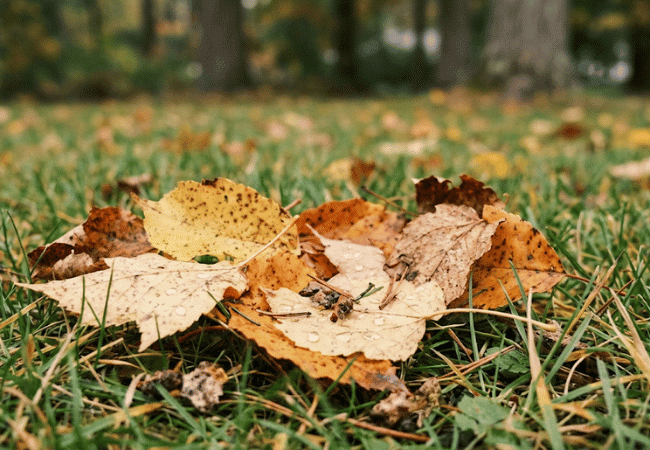
Summer damage often marks the end of an insect’s visible feeding, not the end of its life cycle.
Does Summer Insect Damage Mean You Missed Your Tree’s Treatment Window?
No, since summer damage typically indicates the end of an insect’s visible feeding, not its life cycle. Pests go into fall and winter in different forms:
- Eggs : Spongy moth and spotted lanternfly overwinter as egg masses on bark.
- Active Feeders : Hemlock woolly adelgid keeps feeding on hemlock twigs through winter.
- Stress : A season of summer tree stress can leave a tree more open to pests and disease heading into winter.
How Can You Identify Fall Tree Disease?
You can identify most tree diseases in fall by checking the bark for damage and the leaves on the ground for spotting, then you have to rule out insects. Looking for the following signs can help you tell the problems apart:
- Canker : Sunken, splitting, or blackened bark, often with a thinning canopy and scattered branch dieback, points to canker, a disease that tends to show up on stressed trees.
- Leaf Spots : Irregular brown-black blotches can point to anthracnose or other leaf spot diseases, which rarely harm overall tree health. Raking up and discarding fallen leaves lowers the infection level the following spring.
- Insect Damage : Stripped leaves or a sticky honeydew residue point to insects such as spongy moth or spotted lanternfly rather than disease.
Many diseases look like each other, so you should never guess and always seek a proper diagnosis. At Regal Tree, we handle insect identification and disease diagnosis on site, so there’s no waiting around to find out what’s wrong with your tree.
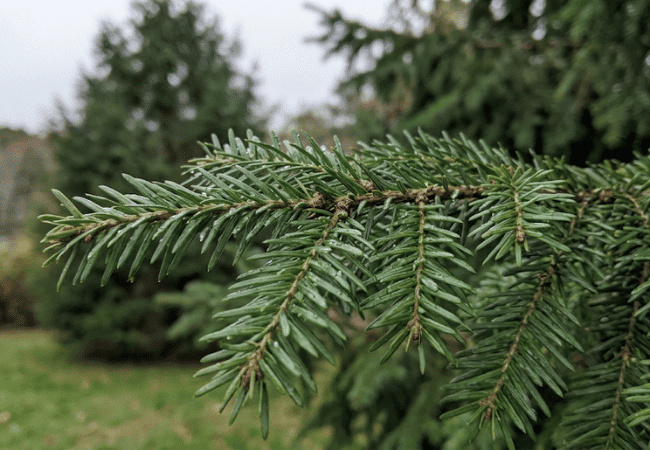
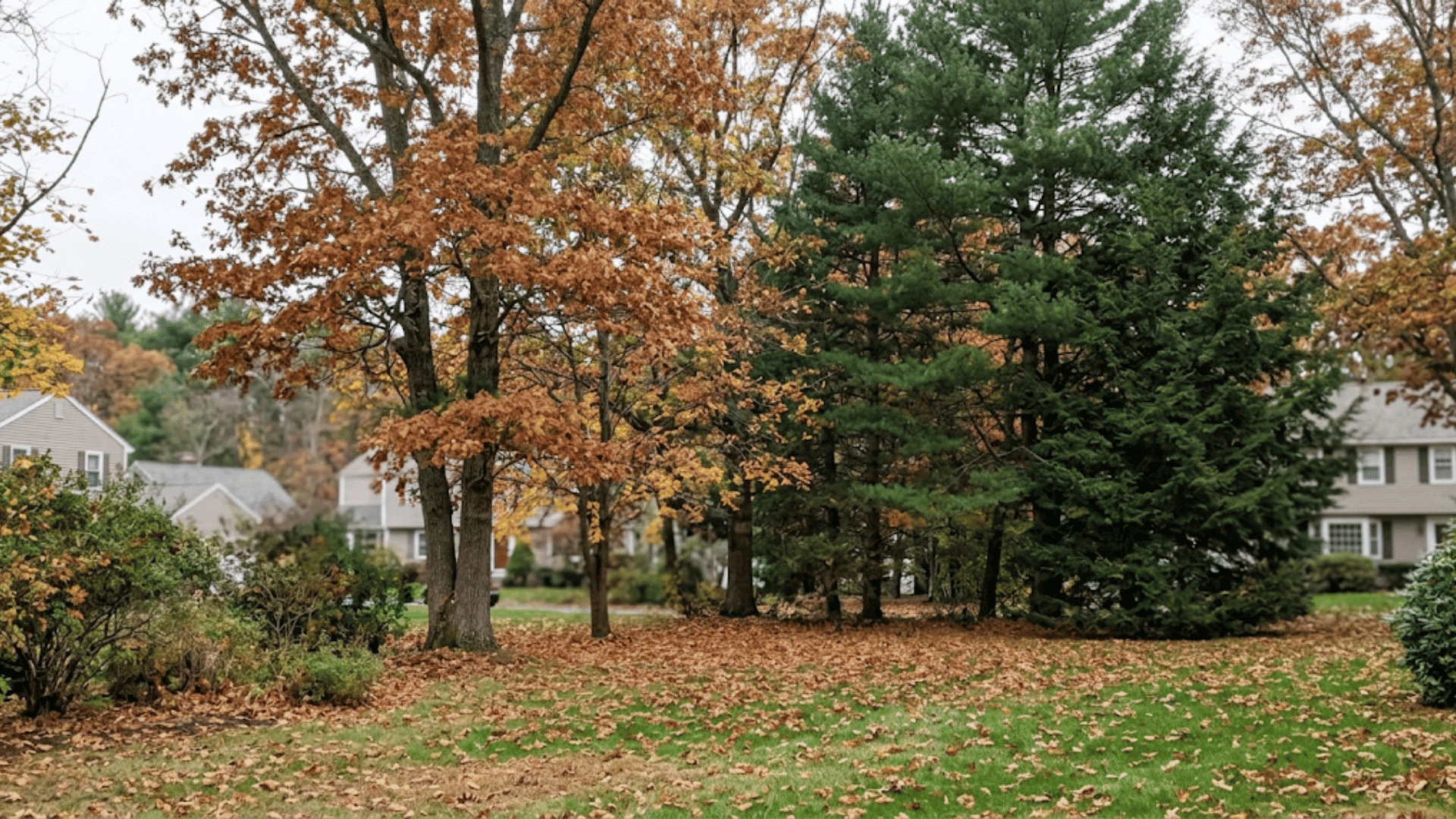
Evergreens like hemlock can still be treated in fall and winter, since some pests keep feeding through the cold months.
When Does Treatment Work for Each Pest Going into Dormant Season?
The window for effective treatment varies by pest; however, most windows run from now through early May. We match each option to the pest and the tree through a specifically tailored tree health management plan, so you’re not paying for a spray that doesn’t work.
Spongy Moth
The treatment window for spongy moth is centered around egg masses. Females usually lay them around early August, and the caterpillars start showing up in early May. Here’s a stage-by-stage plan of action:
- Egg Masses : Soak each mass with a horticultural oil labeled for spongy moth, or scrape it into soapy water and keep the container sealed for two days. Never crush masses or scrape them onto the ground.
- Caterpillars : Btk, a biological insecticide, goes on the foliage soon after they emerge and requires a licensed applicator.
Hemlock Woolly Adelgid
Hemlock woolly adelgid keeps feeding through winter, so a hemlock is still treatable when the growing season’s over. The adelgids usually start feeding again in the middle of October and feed until about early March. There are three available treatment options:
- Dormant Oil Spray : Apply from late March into April, before buds open, on a day that is at least 45°F. Horticultural oil kills all life stages, including eggs.
- Summer-Rate Oil : This works during the growing season on established infestations.
- Imidacloprid (Systemic) : It’s state restricted use in Massachusetts, so a licensed applicator handles it. It takes 8 to 12 weeks to reach the adelgids when applied to soil and 3 to 5 weeks when injected.
Emerald Ash Borer (EAB)
Treatment for EAB has been effective on infested ash when applied before the crown shows over 30%
dieback. Check the top of the tree, where thin or bare branches indicate dieback:
- Under 30% Dieback : An arborist can assess the tree for soil drench or trunk injection, and canopy sprays are not recommended.
- Over 30% Dieback : Results are less certain, so an arborist should assess whether treatment or removal makes sense.
The first beetle in Massachusetts was detected in 2012, and it’s now established throughout the state (including Norfolk County). No treatment can guarantee an outcome.
Scale Insects
Dormant oil spray controls some scale insects in winter, but misses others, depending on how each species overwinters. Oil works by coating the insect, so the stage that overwinters dictates the result:
- Oystershell and Some Pine Needle Scales : Their eggs overwinter stacked under the scale cover, so oil kills only the top layer of eggs and survivors remain.
- Euonymus, San Jose, and Obscure Scales : These overwinter as adult females or immatures, so oil controls them more reliably.
- Japanese Maple Scale : Getting control with dormant oil is difficult.
Oil can burn some plants, like red maples, so always follow the product label exactly.
Spotted Lanternfly
It’s best to treat spotted lanternfly in fall by scraping egg masses off bark before they hatch in the springtime. Adults stay active into December, so fall treatment covers two stages at the same time:
- Egg Masses : The eggs survive typical New England winters, soscrape them into rubbing alcohol or soapy water.
- Active Adults : Vacuum them and remove preferred host plants such as tree-of-heaven. Most adults die off with the first hard frost, though a few linger into December.
The insect is confirmed in over 145 cities and towns in Massachusetts, including Dedham in Norfolk County.
Asian Longhorned Beetle
There isn’t a treatment for Asian longhorned beetle, which means removing the infested tree is the only way to contain its spread. The regulated area is strictly Worcester County, where Shrewsbury became the second community to get rid of the beetle after Holden. If there’s suspicious damage on one of your trees, it’s always a good idea to get it looked at by a professional instead of just trying to treat it yourself.
Winter Moth
Thanks to a parasitic fly, Cyzenis albicans, being established, winter moth is largely under control and now classified as a non-pest. That said, a heavily defoliated tree still deserves an evaluation instead of automatically opting to spray it down.
Box Tree Moth
This moth was initially detected in Massachusetts in August of 2023 on Cape Cod, and has since been found in Plymouth, Brookline, and Newton. These caterpillars feed on boxwood leaves and can strip an entire shrub bare. Keep an eye out for silk webs, insect waste, brown or chewed leaves, and thinning plants. Outside Barnstable County and think you found box tree moth? Report it to the Massachusetts Department of Agricultural Resources.
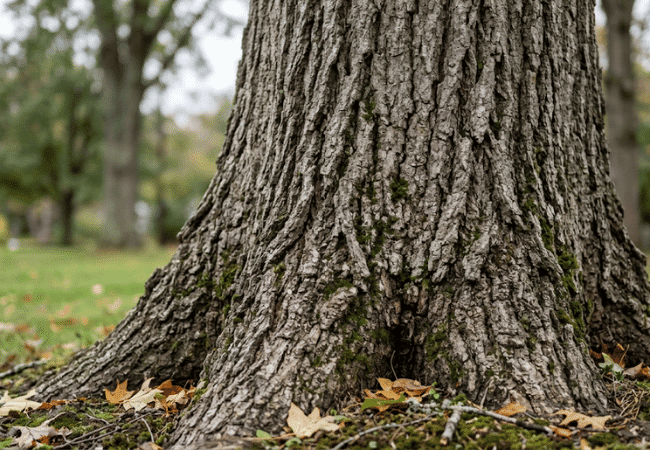
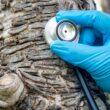
Checking bark in fall helps you tell disease from insect damage before deciding on a treatment.
What Happens If Treatment Waits Until Spring?
Pushing treatment off until spring can be especially costly when it comes to the pests that keep feeding or cross a damage threshold. When it comes to the pests that sit dormant as eggs, the consequences aren’t as dire. Hemlocks keep losing sap until early March, an ash tree can slip past the 30% dieback mark, and spongy moth egg masses turn into caterpillars in early May. Taking action before then gives you more options, though no treatment can guarantee the recovery of a tree.
Frequently Asked Questions About Tree Disease in Fall
Does cold weather kill hemlock woolly adelgid?
Cold helps less than you might hope. Populations have rebounded after mild winters, so a harsh winter may thin them out but is not a treatment plan.
Should you fertilize a hemlock that has adelgids?
No. Nitrogen fertilizer speeds the decline of an infested hemlock, and deep watering during drought is the better way to support it.
When do winter moth eggs hatch?
Eggs hatch around red maple bloom and McIntosh apple green tip. They turn dark blue a day or two before hatching.
Do you need to report spotted lanternfly to the state?
Check the state’s map first. If the insect has not been reported in your city or town, photograph it and submit a report at mass.gov/slf.
Get Treatment Done Right from Regal Tree & Shrub Experts
To have the damage on your trees identified and a treatment timeline matched to it, request a free quote from Regal and we’ll look at what’s happening in your part of the Route 1 corridor.