The South Shore sees a mix of nor’easters, summer microbursts, and the occasional tropical system throughout the year. Those storms place different types of stress on trees, testing everything from branch attachments to root stability.
Most people don’t think about that mechanical stress until something fails. The trees that come down in storms almost always show warning signs beforehand—from a co-dominant stem, significant deadwood, and more. Knowing what to look for, and when to act, is the difference between a close call and a tree in your driveway.
Key Takeaways
- Most storm-related tree failures are preventable because structural defects often develop long before severe weather arrives.
- Structural defects like co-dominant stems, included bark, and significant deadwood are the leading causes of tree failure in storms, and most can be identified and addressed before a storm hits.
- Preventive pruning done in late summer or early fall reduces wind loading and removes failure points ahead of the peak hurricane and nor’easter seasons.
- Cabling, bracing, and tree health management—including plant growth regulators—can significantly improve a structurally vulnerable tree’s storm resilience.
- After a storm, an assessment by an ISA Certified Arborist determines whether a damaged tree can be saved—many can be, with the right restorative care.
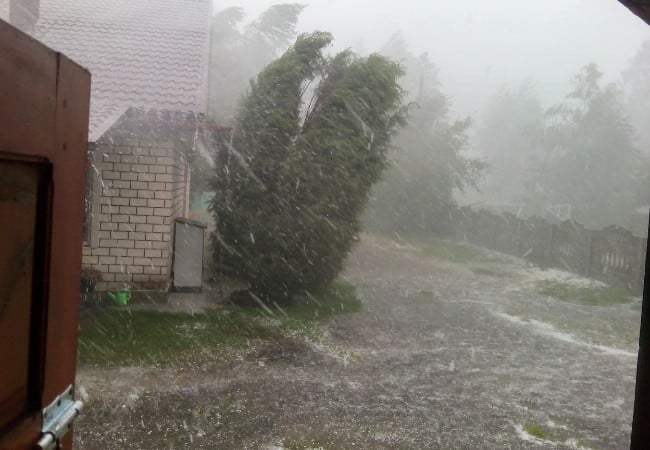
Summer microbursts hit fast and hard—the kind of storm that goes from clear sky to structural damage in minutes.
Why Some Trees Fail in Storms While Others Don’t
Storms don’t usually create tree problems—they expose the ones that were already there. Two neighboring trees can experience the same storm, yet one remains standing while the other loses a large limb or uproots completely. The difference is usually the tree’s structure and overall health.
Different types of storms put stress on trees in different ways:
- Nor’easters bring prolonged winds and saturated soils that test a tree’s root system over many hours.
- Summer microbursts produce sudden, intense winds that can expose weak branch attachments and structural defects.
- Tropical systems combine strong winds with heavy rain, increasing the risk of both limb failure and uprooting.
Healthy trees are built to flex with the wind. Trees with structural defects are not. Problems like co-dominant stems, internal decay, deadwood, weakened roots, and previous storm damage become the tree’s weakest point when severe weather arrives. The good news is that many of these issues can be identified—and often corrected—before the next storm.
How Do You Know If Your Trees Are a Storm Risk Before a Storm Hits?
Several warning signs indicate a tree needs a professional assessment before storm season, and most of them are visible to a careful homeowner willing to walk the property. Although a professional assessment isn’t the only tool and your eyes can be a reasonable first viewer, there are important limits to what a ground-level visual can catch.
The following warning signs warrant an evaluation by a Certified Arborist:
- Co-dominant Stems: Two trunks of roughly equal size competing from a tight V-shaped union, rather than one dominant trunk.
- Included Bark at Branch Unions: Bark that gets pinched between two stems as they grow, creating a mechanical weak point with no real wood-to-wood connection.
- Significant Deadwood in the Upper Canopy: Dead branches have no flexibility and become projectiles in wind.
- Cracks or Splits: Visible cracks in the trunk or major limbs that can worsen under storm stress.
- Leaning Trees or One-Sided Canopies: A significant lean toward a home, driveway, vehicle, or utility line, or a canopy that is noticeably unbalanced.
- Mushrooms or Conks: Fungal growth at the base or on the trunk, which often indicates internal decay.
- Previous Storm Damage or Improper Pruning: Old storm wounds or topping cuts that have weakened the tree’s structure.
- Lifting or Heaving Roots: Large surface roots pulling out of the soil, especially after heavy rain or wind.
Many of the most serious failure risks aren’t visible from the ground at all. Internal decay, root failure, and advanced fungal colonization call for professional diagnostic tools. In high-stakes cases, like a large tree over a structure or a significant specimen worth preserving, we use sonic tomography to map internal wood density without drilling into the tree. If you see any of the previous warning signs, the next step should be an arborist consultation before storms peak.
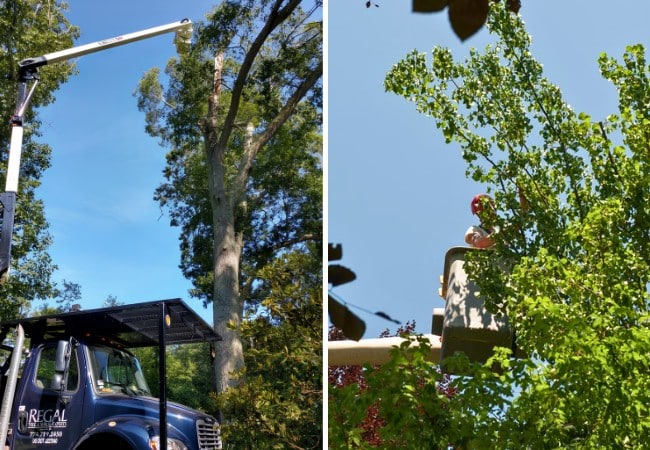
Crown reduction and structural pruning are most effective in the late-summer window—before peak hurricane season, while the canopy is full enough to assess wind load.
How Does Pruning Help Protect Trees from Storm Damage?
For most trees, pruning is the highest-impact storm prep service, as it directly removes or corrects the defects that cause failure. Not all pruning is created equally, though. The work that effectively reduces storm risk falls into three categories.
Deadwood and Hazardous Limb Removal
Dead branches are the most predictable failure point in a storm. They don’t have the same flexibility as live branches and could be beginning to rot or decay if they have been around a while. Branches that have been damaged in previous storms or branches that rub on each other may have weak spots that create a potential hazard. Canopy cleaning removes:
- Deadwood
- Damaged limbs
- Crossing or rubbing branches before they turn into projectiles
For nearly every mature tree in the region, this is the baseline storm prep service.
Crown Reduction and Canopy Thinning for Wind Resistance
A full, dense canopy acts like a sail in high winds. The bigger the surface area, the bigger the wind load—directly translating into more uprooting force at the root zone. Crown reduction shortens extended limbs to reduce the lever arm effect on the root system; canopy thinning removes selective interior branches to improve airflow through the canopy without greatly affecting its shape.
Each approach reduces mechanical stress at the root zone, which is especially important in the clay soils and coastal lowlands throughout the South Shore. A tree that sheds wind instead of catching it puts a lot less stress on an already-challenged root system.
Structural Pruning to Correct Weak Branch Unions
Co-dominant stems and tight crotches, the V-shaped unions that show included bark, are the structural defects most likely to produce catastrophic failure in a storm. In younger trees, structural pruning can directly correct the problem: by removing or subordinating the competing leader early, while the tree still has decades of growth ahead.
The late-summer to early-fall window (July through September) is ideal for storm-resistance pruning in this region. With the leaves still on, it’s easier to assess wind load and canopy density. The worst of hurricane season is yet to come, so the work precedes the peak risk window.
Can Cabling, Bracing, and Tree Health Management Help Trees in Storms?
Yes. Both cabling and proactive tree health management can significantly limit the storm risk of trees that aren’t candidates for removal but have structural vulnerabilities that pruning alone doesn’t address fully.
Cabling and Bracing for Structural Support
Cabling installs high-strength steel cables between co-dominant stems or extended limbs to redistribute load and limit movement at weak unions. It doesn’t eliminate the structural defect, but it greatly reduces the probability of failure by preventing the stems from separating under wind stress.
Bracing uses threaded steel rods installed through split or cracking unions to provide rigid support at the point of failure. It’s the right tool when a union is already showing a crack or separation that cabling alone can’t address.
Both systems should be installed to ANSI A300 standards and annual inspection is recommended, as hardware wears down over time while the tree continues to grow around it. Cabling and bracing are supplemental to pruning, not a substitute, and the most effective approaches combine them.
Tree Health Management and Plant Growth Regulators
A tree under drought stress is much more vulnerable to storm failure than a healthy, well-hydrated one. Stress compromises the cellular defenses that:
- Help trees compartmentalize wounds
- Weakens root function
- Reduces the tree’s ability to recover from storm damage when it happens
This is why summer tree health management is about more than just disease prevention; it’s directly connected to how well your trees perform in a storm.
Plant growth regulators, or PGRs, redirect energy from shoot growth toward root development, which increases fine root density and improves anchorage in the soil.
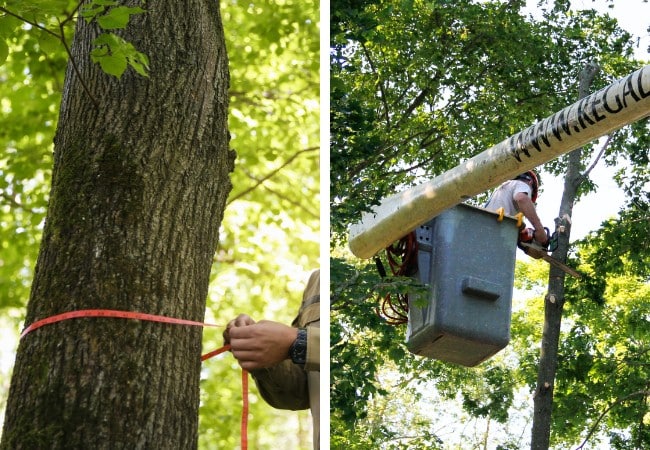
A professional assessment catches what a ground-level walk-through misses—and the right pruning cut made now is far less expensive than emergency removal after a storm.
Frequently Asked Questions About Protecting Trees from Storm Damage
How do I prepare my trees for storm season in Massachusetts?
Start with a professional inspection to identify structural defects that increase failure risk. Follow with any recommended pruning, cabling, or tree health management. The late-summer window (July–September) is the optimal time for this work ahead of both hurricane and nor’easter season.
What trees are most likely to fall in a storm?
Trees with structural defects as well as those with significant deadwood, root damage, or internal decay from fungal disease are the most vulnerable. Site conditions also matter: trees in compacted or saturated clay soils have reduced root anchorage, which increases uprooting risk in high winds.
What is tree cabling and bracing?
Cabling uses high-strength steel cables between branches or stems to redistribute load and limit movement at weak unions. Bracing installs steel rods through cracking or split unions for rigid support. Both are effective at reducing failure risk when installed to ANSI A300 standards—but they supplement, rather than replace, structural pruning.
Can a damaged tree be saved after a storm?
Many can be. The key indicator is whether 50% or more of the crown remains intact. A professional assessment determines whether the damage is structural or primarily cosmetic, and whether restorative pruning, cabling, or the Tree Recovery Program is the right path forward.
When is the best time to prune trees for storm protection?
Late summer through early fall—July through October—is the optimal window in the South Shore and Providence County region. That puts the work ahead of nor’easter season, while the canopy is still full enough to assess wind load, and early enough for pruning wounds to begin closing before dormancy.
Get Professional Help Protecting Your Trees Before the Next Storm
Our team at Regal Tree & Shrub Experts includes an ISA Certified Arborist, a dedicated tree health management program, and 24/7 emergency service for when storms don’t wait for business hours.
We conduct formal risk assessments using the TRAQ methodology—the ISA’s standardized framework for documented tree risk evaluation—so you get a systematic assessment, not a general walk-through. If you want to understand your trees’ condition before the next major storm, schedule a consultation or call us at 774-719-2450, and we’ll identify any risks and recommend the most appropriate next steps.