Every winter, mature trees in South Easton and Wellesley reveal secrets that remain hidden during the growing season. As leaves fall and dormancy sets in, the true structural condition of your property’s trees becomes visible for the first time since spring. This makes winter one of the most important times to assess tree safety and address potential hazards before severe weather arrives.
What Certified Arborists discover during winter evaluations often determines whether your trees can be preserved with preventive care – or require emergency removal after the next storm if ignored.
Key Takeaways
- Winter dormancy reveals hidden structural problems that summer foliage completely obscures, giving Certified Arborists the clearest view of your trees’ true condition.
- Professional winter assessments prevent dangerous tree failures by identifying structural defects before spring storms create emergency situations that threaten your property and family.
- Sonic tomography testing during winter provides the most accurate detection of internal decay because reduced moisture and dormant sap flow eliminate interference with sound wave readings.
- Early winter identification of tree problems enables planned treatment scheduling during optimal spring timing, resulting in better tree health outcomes and lower costs than emergency services.
- Species-specific winter evaluation targets the most common failure patterns in local red oaks and sugar maples, addressing the structural issues most likely to affect mature trees in Norfolk County neighborhoods.
How Winter Weather Helps Accurately Diagnose Structural Defects
Winter creates ideal conditions for identifying hidden tree hazards because:
- The canopy is gone, eliminating the leafy cover that hides cracks, weak unions, and decay during the growing season.
- Dormancy exposes structural weaknesses, as trees pull energy back from their outer limbs, making defects easier for arborists to spot.
- Internal decay becomes more visible, especially in established Norfolk County neighborhoods where mature trees often hide long-developing issues.
- Sap flow has slowed or stopped, allowing advanced diagnostic tools to produce more accurate readings.
- Problem areas stand out clearly, helping Certified Arborists distinguish between cosmetic issues and defects that could lead to major failure.
PRO TIP: Schedule winter assessments between December and February when trees have been dormant long enough for complete leaf drop but before spring sap flow begins.
What Are the Most Dangerous Tree Defects Found in Winter?
Professional winter evaluations consistently identify three structural problems that pose the greatest threats to Norfolk County properties. Understanding these defects helps homeowners recognize when immediate action prevents emergency situations.
1. Co-Dominant Stems
The most dangerous structural defect revealed during winter assessments is co-dominant stems with included bark. These V-shaped unions create weak attachment points where bark grows between two main stems, preventing strong wood connections from forming.
Research from UMass Extension storm damage studies shows that trees with co-dominant stems have significantly higher failure rates during winter storms. Without leaf cover, these defects become clearly visible to Certified Arborists.
Assessment criteria for co-dominant stems include:
- Stems larger than 4 inches with included bark: May require urgent removal due to high failure probability
- Stems 2-4 inches with minimal bark inclusion: Can often be corrected through structural pruning
- Young stems under 2 inches: Ideal candidates for corrective pruning to establish a single dominant leader

Decay inside of a tree that was revealed during a tree removal.
2. Tree Decay
Internal decay in a tree can cause it to fall unexpectedly during a winter storm. The worst part is that it is very difficult to detect without the proper tools. That’s where Certified Arborists and sonic tomography assessments come in handy.
How Does Sonic Tomography Detect Tree Decay
Winter conditions provide optimal circumstances for sonic tomography assessments that detect internal decay invisible to the naked eye. This technology uses sound waves to map a tree’s interior structure, revealing areas of compromised wood strength.
The process measures sound wave velocity through wood tissue. Healthy wood transmits sound rapidly, while decayed areas show significantly slower transmission. Winter’s reduced moisture content and absence of sap flow provide the most accurate readings possible.
Common decay patterns discovered include:
- Heart Rot in Red Oaks: Often develops from old pruning wounds or storm damage
- Butt Rot in Sugar Maples: Typically starts from root damage or soil compaction
- Progressive Trunk Decay: Spreads vertically through the tree, weakening the overall structure
“Winter sonic tomography has revolutionized how we evaluate tree safety. What we discover during dormant season testing often determines whether a tree can be preserved or requires removal to prevent failure.” – Kevin Johnston, Owner and ISA Certified Arborist at Regal Tree

Winter storms can be just as damaging in Massachusetts as summer hurricanes.
3. Dead and Weakly Attached Branches
Winter assessments reveal the full extent of dead and weakly attached branches that pose immediate safety risks. Without foliage to disguise branch condition, Certified Arborists identify hazardous deadwood before it falls during the next storm.
The systematic evaluation process includes:
- Visual bark assessment for slippage, discoloration, or absence of living tissue
- Attachment point evaluation for cracking, splitting, or movement under wind load
- Size and location analysis to determine immediate versus spring removal priorities
Branches over two inches in diameter near homes, vehicles, or walkways require immediate attention regardless of season. Smaller deadwood can often wait for optimal spring scheduling.
Species-Specific Tree Risks to Watch for in the Winter
The most common trees in local neighborhoods show specific structural characteristics that become apparent during winter assessment. Understanding these patterns helps homeowners recognize potential problems before they become dangerous.
Red Oak
Red oaks dominate mature neighborhoods throughout the region and typically develop predictable structural patterns. These large specimens require focused attention on specific defect types.
Winter assessment priorities include:
- Co-dominant stem development in open-grown conditions
- Heart rot susceptibility from Armillaria and other decay fungi
- Branch attachment strength variations based on growth history
- Trunk integrity evaluation for major structural defects
Sugar Maple
Sugar maples in Wellesley’s Tree City USA districts and throughout the area require specialized winter evaluation due to their structural characteristics.
Key assessment focuses include:
- Multiple stem development from an early age requires bark inclusion evaluation
- Shallow root system vulnerable to construction damage
- Butt rot development from root system stress or grade changes
- Early decay detection through sonic tomography testing
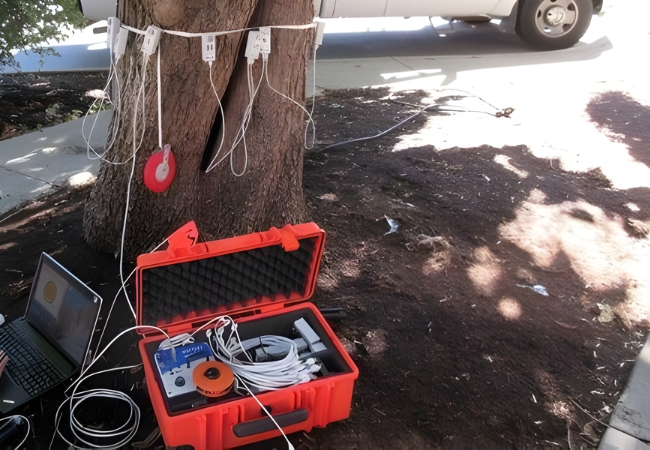
Sonic tomography equipment, used by the Regal Tree arborist to assess the internal condition of a tree.
Frequently Asked Questions About Winter Tree Assessments
When do trees need immediate winter attention?
Trees require immediate intervention when structural defects pose imminent safety risks, including co-dominant stems larger than 4 inches with included bark, internal decay affecting more than 40% of trunk cross-section, or dead branches over 2 inches near structures.
What makes winter the best time for tree assessment?
Winter dormancy eliminates leaf cover that obscures structural defects during growing season. Reduced sap flow and moisture content also provide optimal conditions for accurate sonic tomography testing and visual evaluation.
How accurate is sonic tomography for detecting decay?
Sonic tomography provides highly accurate detection of internal decay patterns using non-invasive sound wave technology. Winter conditions enhance accuracy by reducing moisture interference, making it the most reliable method for assessing internal tree structure.
Can winter assessments prevent spring emergencies?
Yes, comprehensive winter assessments identify potential failure points before spring weather creates emergency situations. Early detection enables planned interventions at optimal times, preventing costly emergency services and reducing safety risks.
Get Professional Tree Assessment Services in Norfolk County Today from Regal Tree
Professional winter assessments reveal hidden structural problems before they become dangerous. Regal Tree’s ISA Certified Arborists use advanced diagnostic techniques to identify critical defects during optimal dormant season conditions.
Call 774-719-2450 or request your free quote to schedule your winter tree assessment in South Easton, Medfield, Wellesley, or surrounding communities.